Brain and Intelligence Lunch Seminar NO.35

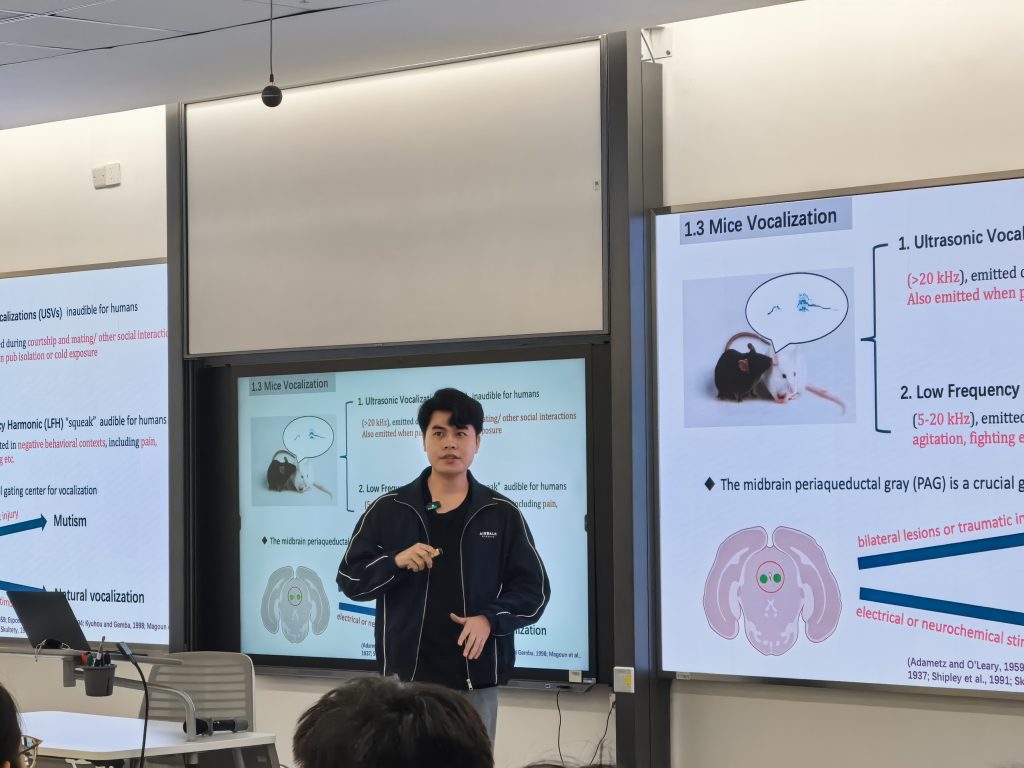
On March 18, to further inspire students' enthusiasm for scientific research and enhance their academic communication skills, the Brain and Intelligence Research Institute launched a student-led seminar series. In this session, doctoral student Liao Qingliang, from the research team of Assistant Professor Zhang Xian, served as the speaker. He presented his research findings titled “A genetically defined midbrain-pontine circuit gates vocal communication,” attracting approximately 60 faculty members and students.
In his presentation, Liao elaborated on a newly identified population of somatostatin-expressing neurons in the lateral and ventrolateral periaqueductal gray (l/vlPAGSST) that functions as a premotor gate for ultrasonic vocalizations in mice. Using in vivo calcium imaging, optogenetics, and projection-specific manipulations, his study demonstrated that these neurons are selectively recruited around vocal onset and that their activation prolongs call duration by coordinating respiratory, laryngeal, and orofacial motor programs. Notably, the descending glutamatergic projections from l/vlPAGSST neurons to the dorsal pontine tegmentum were identified as sufficient to drive vocal production.The presentation was followed by an engaging discussion among attendees, covering topics ranging from circuit specificity to translational implications.
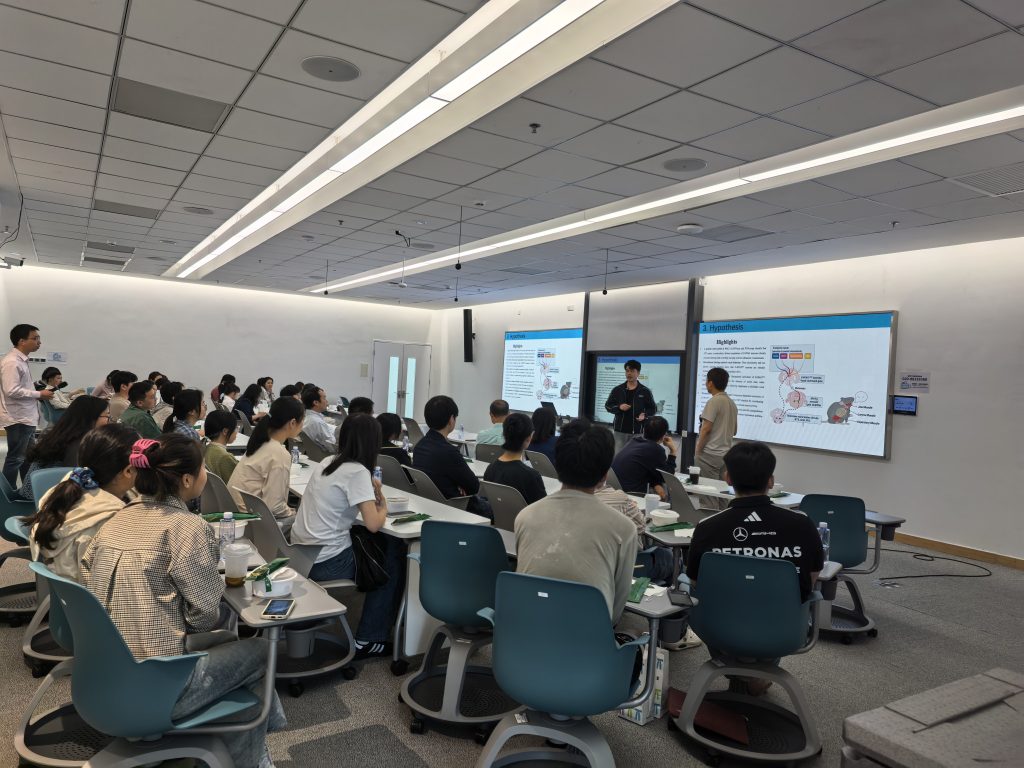
The Brain and Intelligence Lunch Seminar aims to promote subject integration and in-depth exchanges in the fields of brain science and artificial intelligence and create a relaxed and open academic exchange atmosphere for teachers and students to jointly discuss the cutting-edge scientific trends of brain and intelligence. We look forward to more experts, scholars and young talents joining us to jointly promote the prosperity and development of frontier fields related to brain and intelligence.


About Lab
The Zhang Lab was established in 2022 and is affiliated with the Brain and Intelligence Institute, within the Bioscience and Biomedical Engineering Thrust (BSBE) at the Systems Hub of the Hong Kong University of Science and Technology (HKUST GZ). Our lab is dedicated to advancing the understanding of the neural mechanisms that underlie emotional responses and behaviors critical for survival and social interaction.
Our research focuses on studying the complexities of neural circuits and their information encoding processes, which are crucial for comprehending brain function and the origins of neurological disorders. We investigate how neurons within these distributed circuits convert external stimuli into internal states and subsequently govern motivated behaviors. Key areas of interest include the production of vocalization and the influence of emotions on vocal outputs, the impact of stress on sleep patterns, and the modulation of hunting behaviors.
We welcome you to join us in exploring these fascinating aspects of neuroscience and contribute to advancing research in this dynamic field.