BSBE Forum Brain and intelligence Seminar
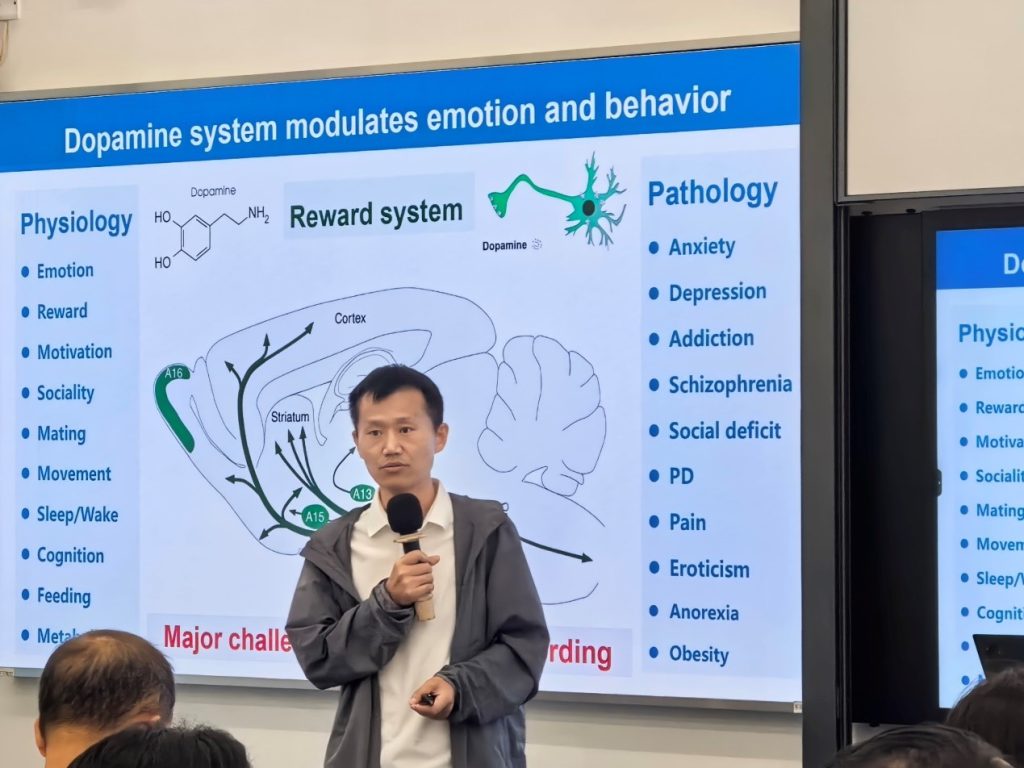
On 16 September 2026, the BSBE Forum Brain and intelligence Seminar was successfully held. Hosted by Prof. Xian ZHANG, this session featured Prof. Changhe Wang from Xi‘an Jiaotong University, who presented a talk entitled “Neural mechanisms of behavioral decision-making”.
Animals need to adjust behavioral decisions (such as socialization, exploration, fighting, mating, reproduction, etc.) in real time based on internal physiological needs and changes in the external environment to obtain maximum benefits in survival and reproduction. However, as the behavioral decision-making center, the dopamine system accurately and dynamically encodes behavioral decisions in real time is unclear.
By developing ultra-high spatial and temporal resolution and ultra-sensitive electrochemical detection methods for dopamine secretion, Professor Wang Changhe's team recorded two different dopamine release modes: phasic release and tonic release. The study found that in the context of behavioral decision-making, dopamine neurons mediate two dopamine secretion modes through two types of discharge modes (phasic vs tonic). Phased dopamine release preferentially promotes D1 receptor-mediated synaptic transmission, while tonic release mainly activates D2 receptor-mediated pathways. It was further found that this biased synaptic transmission is the core mechanism for encoding social decision-making and exploratory decision-making, and then established a theoretical model of dopamine-biased synaptic transmission.
In the study of exploratory decision-making, the team further identified dopaminergic neurons in the ventral tegmental area (VTA^DA^ neurons) as a central hub encoding exploration decisions. Phasic firing encodes risky vigilance via D1 receptor-mediated synaptic transmission, while tonic firing encodes exploration motivation via D2 receptor-mediated transmission. Two subpopulations of VTA^DA^ neurons project via direct and indirect pathways onto the same subpopulation of basolateral amygdala neurons. The indirect pathway, with the medial prefrontal cortex as an intermediate node, mediates exploratory behavior and is reinforced by social interaction, whereas the direct pathway mediates avoidance behavior. The dynamic interplay between these two competing dopamine pathways coordinately encodes the formation of exploration decisions.
The study also employed multiple novel behavioral paradigms to quantify the impact of social activity on risk exploration in mice. The presence of a social companion significantly increased deep exploration behavior and reduced avoidance behavior in threatening contexts, revealing a “social encouragement effect” on risk exploration. These findings not only elucidate the core encoding mechanism of dopamine neuron firing patterns in exploration decisions but also reveal a novel mechanism of dopamine conjugated projection circuit integration, establishing a new theory of dopamine-biased synaptic transmission.

The BSBE Forum aims to foster interdisciplinary exchange in bioscience and biomedical engineering, providing faculty and students with an open platform to discuss cutting-edge research. We look forward to welcoming more experts and scholars to join us in advancing the field.